As AI adoption moves from experimentation to execution, the story is shifting.
It’s no longer just about model releases or productivity gains — it’s about how work itself is being restructured, who benefits, and who is at risk of being left behind.
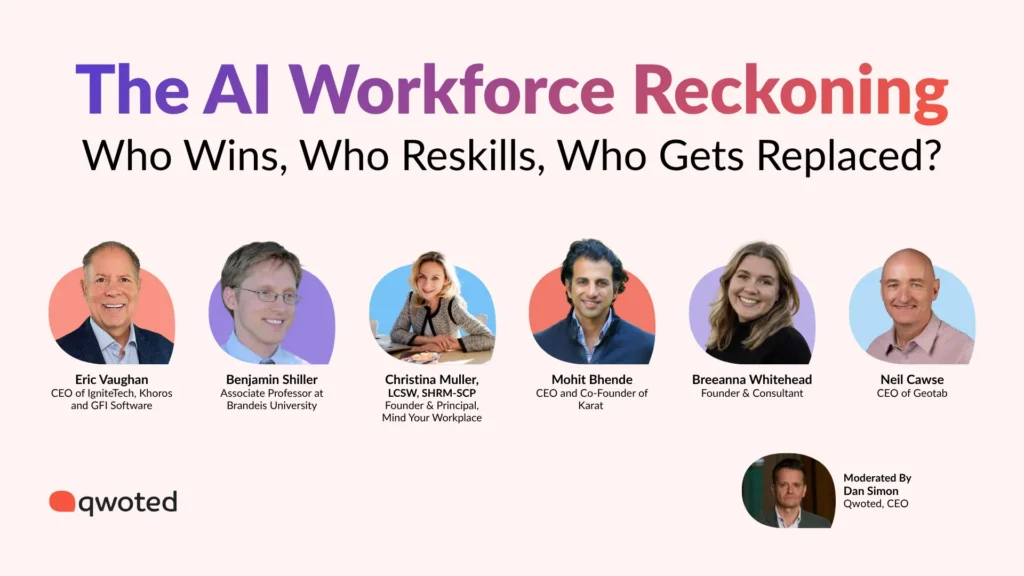
In a recent Qwoted panel, “The AI Workforce Reckoning: Who Wins, Who Reskills, Who Gets Replaced?”, six experts across economics, enterprise leadership, hiring, and workplace psychology unpacked what’s actually happening inside organizations right now, and what journalists should be paying attention to next.
The Narrative Around AI and Jobs Is Already Distorted
One of the clearest tensions to emerge: the public narrative about AI and jobs may not match reality.
Eric Vaughan, CEO of IgniteTech, introduced the concept of “AI washing” — companies attributing layoffs to AI when broader restructuring is often the real driver.
“Large companies are saying they’re reducing headcount because of AI when they’re really just adjusting workforces.”
At the same time, Vaughan pushed back on the idea that AI simply eliminates jobs:
“We are hiring more people than we had pre-AI… it’s about humans commanding AI.”
For reporters, this opens a key angle:
How much of the AI layoffs narrative is real, and how much is framing?
AI Is Restructuring Work, Not Just Replacing It
Across the panel, there was broad agreement that AI is changing the structure of work more than eliminating it outright — but unevenly.
Neil Cawse, CEO of Geotab, emphasized both opportunity and uncertainty:
“We’ve seen technological revolutions before… but there’s still uncertainty regarding the long-term impact of AI on jobs.”
His expectation: adaptability will define outcomes.
“Workers must… embrace AI and be ready to shift roles as needed.”
Meanwhile, Professor Benjamin Shiller, economist and author, highlighted the secondary effects of disruption:
“Even if your job isn’t directly impacted… displaced workers will enter unaffected fields, driving supply up—and wages down.”
Story angle:
AI’s biggest impact may not be job loss, but job redistribution and wage pressure across the economy.
The Divide Isn’t Job vs. No Job — It’s AI-Adopters vs. Everyone Else
A recurring theme: the real divide may not be between industries or roles, but between workers who effectively use AI and those who don’t.
Vaughan framed it bluntly:
“AI will absolutely displace people who refuse to use AI… but every job can adapt.”
This aligns with the view of Mohit Bhende, CEO and Co-founder of Karat, from the hiring and engineering side. He pointed to a shift in how companies evaluate talent — with AI fluency and adaptability becoming core signals.
At the same time, Bhende noted that growth is not evenly distributed:
“We’re seeing significant growth in sectors like healthcare, retail, and banking… where human oversight is critical.”
Bhende continued: “I predict domain expertise is about to matter more than it has in 20 years. AI is handling more of the production layer, so the human premium goes to engineers who actually understand the industry they’re building for — finance, healthcare, energy. The generalist era is ending.”
Story angle:
The next labor divide may be AI fluency, not education or experience.
Entry-Level Work Is Being Rewritten in Real Time
One of the most immediate areas of disruption: entry-level roles.
Cawse raised concerns that traditional on-ramps into the workforce may shrink:
“Entry-level engineers will struggle—companies increasingly look to AI-native candidates.”
Shiller offered a counterpoint, suggesting entry-level work won’t disappear — but will change:
“Prompt engineering… is the ‘new grunt work’ supporting executives working with AI.”
Story angle:
What replaces entry-level work — and how do workers gain experience in an AI-first system?
The Psychological Impact of AI Is Becoming a Business Issue
While much AI coverage focuses on productivity, the panel highlighted a less-covered dimension: mental and emotional impact.
Christina Muller, a licensed clinical social worker and workplace mental health expert, emphasized that AI is reshaping not just tasks, but how people think and experience work:
“People fear being replaceable… leaders must communicate that AI is a co-pilot.”
She also warned against “cognitive offloading” — over-reliance on AI reducing critical thinking.
As Muller explains, “The relationship between AI and the brain is bidirectional. How we use AI shapes the brain over time, and the state of the brain shapes how we end up using or depending on it. Leaders need to be intentional when designing work with AI while never losing sight of the organ doing the work.”
Breeanna Whitehead, AI strategist and founder, added a broader cultural lens:
“AI is now the smartest person in the room… so the value system in the workplace has to shift.”
Story angle:
AI isn’t just changing work — it’s changing identity, confidence, and decision-making inside organizations.
Productivity vs. Creativity Is the New Strategic Tension
Another emerging divide: companies optimizing for efficiency vs. innovation.
Bhende noted that leading organizations are moving beyond cost-cutting:
“Productivity is a trap. Companies obsessing over AI efficiency gains are optimizing within the framework of what already exists — and that’s exactly how you lose. The future economy belongs to creators, not optimizers. The question won’t be how much more productive you get – it’ll be what net new things you build that drive max gains to customers.”
Whitehead echoed this, cautioning against over-automation:
“Over-reliance on AI risks flattening human creativity and real-world learning.”
Story angle:
Will AI-first companies prioritize efficiency — or entirely new products and experiences?
Journalism Itself Is Not Immune
The conversation turned inward at points, with panelists acknowledging AI’s impact on media.
Concerns ranged from monetization to content quality:
- The rise of “AI slop” — low-quality automated content
- The importance of human voice and trust in reporting
- The shift toward platforms that emphasize individual credibility
As Muller put it:
“Readers connect better with authentic human storytelling.”
Story angle:
How AI is reshaping not just coverage, but who and what audiences trust.
What Journalists Should Watch Next
Across the discussion, a few themes stood out as particularly important for ongoing coverage:
- The gap between AI narrative vs. operational reality
- The rise of AI-native workers and organizations
- The restructuring of entry-level pathways
- The growing importance of psychological safety and leadership
- The uneven distribution of AI impact across industries
The takeaway: this isn’t a single story about automation or layoffs.
It’s a broader shift in how work is defined, valued, and experienced — and it’s still unfolding.
If you’re covering AI, labor, or the future of work, Qwoted can connect you directly with the panelists featured in this discussion, plus help you post a request for expertise across our vetted network.
👉 Connect directly with these experts on the Qwoted network:
- Benjamin Shiller: Economist and Professor, Brandeis University
Connect on Qwoted - Eric Vaughan: CEO, IgniteTech, Khoros, and GFI Software
Connect on Qwoted - Christina Muller, LCSW, SHRM-SCP: Workplace mental health & HR expert
Connect on Qwoted - Mohit Bhende: CEO & Co-founder, Karat
Connect on Qwoted - Neil Cawse: CEO & Founder, Geotab
Connect on Qwoted - Breeanna Whitehead: AI strategist & founder
Connect on Qwoted